

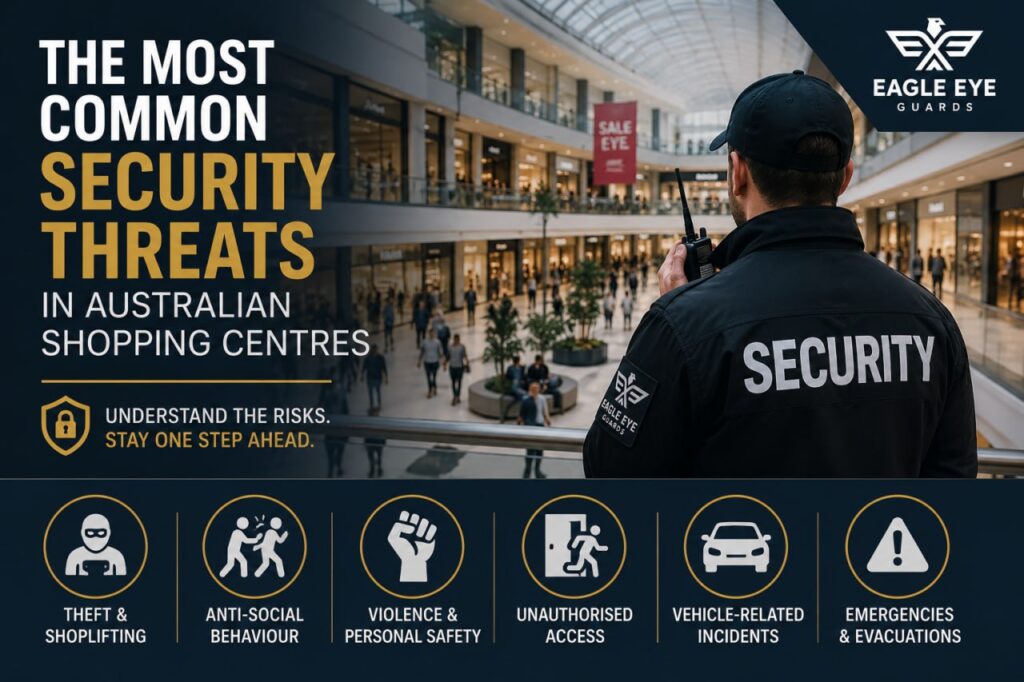
Shopping centres are among the busiest public spaces in Australia. From early morning deliveries to late-night closing shifts, they attract thousands of people daily — and with high foot traffic comes an equally high potential for security incidents.
Whether you manage a large retail precinct in Melbourne’s CBD or a suburban shopping strip in Darwin, understanding the threats you face is the first step to addressing them. Here are the most common security threats in Australian shopping centres and what can be done about each.
Shoplifting and Retail Theft
Shoplifting remains the single biggest security challenge for Australian retailers. It ranges from opportunistic theft — someone pocketing an item on impulse — to highly coordinated group efforts where multiple individuals work together to overwhelm staff and exit quickly.
What makes it particularly damaging is that most incidents go unnoticed or unreported. Retailers often absorb the loss quietly, not realising how quickly it compounds over a financial year.
A visible, trained security presence on the floor acts as one of the most effective deterrents. When customers and potential offenders can see a professional guard actively monitoring the environment, the risk of opportunistic theft drops significantly.
Organized Retail Crime (ORC)
Organized retail crime is a step above everyday shoplifting. It involves coordinated groups that target specific high-value products — electronics, cosmetics, baby formula, and clothing are common targets — with the intention of reselling stolen goods.
These groups often conduct surveillance of a centre before acting, identify gaps in security coverage, and plan their exit routes in advance. They are not deterred by CCTV alone.
Tackling ORC requires consistent guard patrols, strong communication between retailers within the centre, and clear incident reporting systems that help identify repeat offenders.
Antisocial Behaviour and Loitering
Shopping centres, particularly those near public transport hubs, can become gathering spots for groups engaging in antisocial behaviour. This includes loud and intimidating conduct, harassment of staff or customers, vandalism of amenities, and alcohol or drug-related incidents.
Left unaddressed, antisocial behaviour creates an unwelcoming environment that drives away genuine shoppers and puts staff in uncomfortable — sometimes
unsafe — situations.
Professional security guards are trained in de-escalation techniques, allowing them to manage these situations calmly and confidently without the need for confrontation or police intervention in most cases.
Slip, Trip, and Public Safety Incidents
While not a traditional “security” threat, public safety incidents are a significant liability concern for shopping centre managers. Wet floors, cluttered walkways, malfunctioning escalators, and poor lighting in car parks all create conditions where accidents happen.
Security guards play a direct role in identifying and reporting these hazards during patrols. Their presence also means faster response when an incident does occur — whether that means calling emergency services, cordoning off a hazard, or providing first aid support until help arrives.
Car Park Crime
Shopping centre car parks are consistently among the most vulnerable areas on any retail property. Vehicle theft, break-ins, and personal robberies are all more likely to occur in car parks than inside the centre itself.
Poor lighting, limited visibility between rows of vehicles, and the natural isolation of multi-level structures all contribute to this risk. Regular security patrols — both on foot and by vehicle — significantly reduce the likelihood of incidents and give customers greater confidence when walking to and from their cars, particularly after dark.
Staff Disputes and Internal Theft
Internal theft — where employees steal from their own employer — accounts for a surprisingly large proportion of retail losses in Australia. It often goes undetected for longer than external theft because the individuals involved understand store systems and routines.
Beyond theft, staff disputes and workplace altercations occasionally escalate in ways that require third-party intervention. Having a professional security presence helps de-escalate these situations discreetly and protects both staff and management.
Emergency Situations and Evacuation Management
Fire alarms, medical emergencies, bomb threats, and active threat scenarios are rare but demand a structured, practiced response. In a busy shopping centre, the challenge of managing large crowds during an emergency cannot be underestimated.
Trained security personnel are often the first responders in these situations. They coordinate crowd movement, assist individuals who need help, communicate with emergency services, and help prevent the panic that leads to additional injuries.
Having a security team that has rehearsed emergency procedures specific to your centre is not optional — it is a critical part of responsible centre management.
Fraud and Point-of-Sale Scams
Increasingly, security threats are extending beyond the physical environment. Fraudulent returns, counterfeit currency, and point-of-sale scams are becoming more sophisticated. While these often require internal systems and staff training to address, security personnel support the process by monitoring flagged individuals and assisting when a situation needs to be escalated.
How Professional Security Guards Address These Threats
Across all of the above, one factor consistently reduces the frequency and severity of security incidents: a trained, licensed, and visible security team.
Professional guards provide more than a physical presence. They observe patterns of behaviour, build familiarity with regular visitors, communicate in real time with retail staff and centre management, and respond to incidents in a way that minimises risk and liability.
At Eagle Eye Guards, our team is trained to operate in complex, high-traffic retail environments across Melbourne and Darwin. We work closely with centre management to understand the specific layout, tenant mix, and risk profile of each location — and we tailor our approach accordingly.
Final Thoughts
Australian shopping centres face a wide and evolving range of security challenges. The good news is that most of these threats are manageable with the right people, processes, and presence in place.
If you manage a shopping centre or retail precinct and want to understand how a professional security team could improve safety outcomes for your tenants and customers, get in touch with Eagle Eye Guards today.
Ready to improve security at your shopping centre? Contact Eagle Eye Guards on 1300 236 040 or visit eagleeyeguards.com.au to request a free security assessment.
