

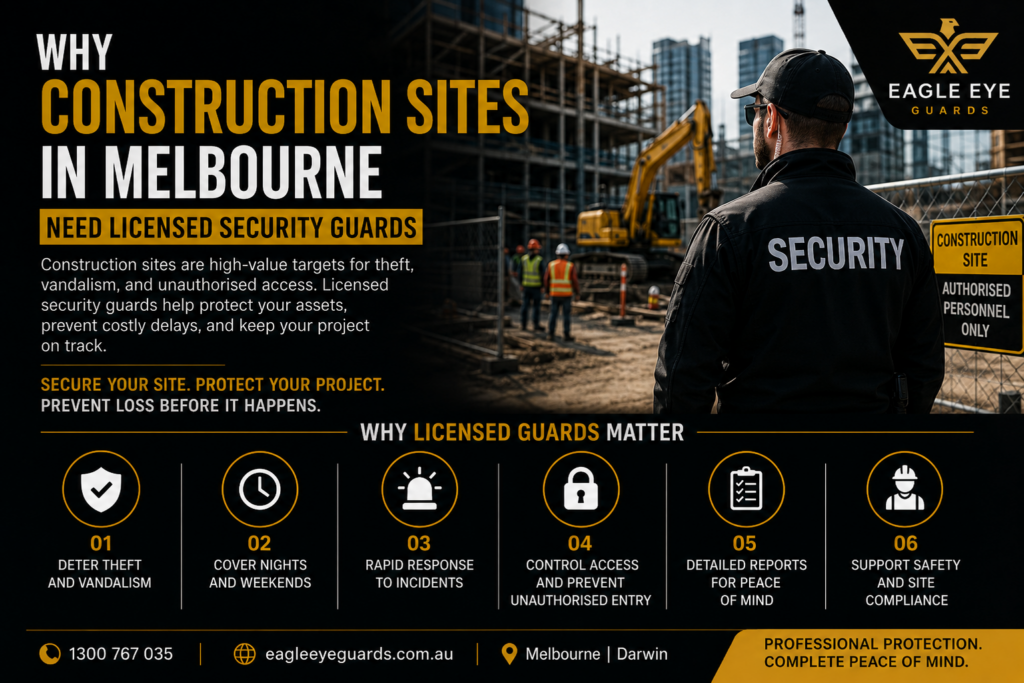
Why Construction Sites in Melbourne Need Licensed Security Guards
Melbourne is in the middle of a sustained construction boom — new residential developments, commercial towers, and infrastructure projects are underway across the city at any given time. That growth comes with a downside: building sites are one of the most targeted environments for theft, vandalism, and unauthorised access in the state. For builders and project managers, security isn’t a nice-to-have add-on. It’s part of running a site properly.
Here’s why licensed security guards have become essential on Melbourne construction sites, and what to look for when hiring one.
Construction Sites Are a High-Value, Low-Protection Target
Building sites are, by nature, exposed. Materials, tools, and machinery often sit in open or semi-secured areas for weeks at a time. Fencing and signage are usually the only barrier, and once trades leave for the day — especially over a weekend — a site can sit completely unattended for 48 hours or more.
That combination of high-value assets and low supervision makes construction sites an easy target. Industry estimates put theft and vandalism losses across the Australian construction sector in the hundreds of millions of dollars every year, and Victoria is consistently named as one of the states most affected, largely due to the sheer volume of active building work concentrated in and around Melbourne.
What’s Actually Being Stolen
Understanding what thieves go after helps explain why a passive approach — a fence and a padlock — isn’t enough anymore:
- Power tools — drills, saws, grinders, and nail guns are compact, easy to carry, and simple to resell
- Copper wire and plumbing fittings — copper theft has surged sharply across Victoria in recent years, driven by resale value, and is a particular risk during the rough-in stage before walls are closed up
- Fuel and batteries — diesel and equipment batteries are consistently targeted on larger sites
- Machinery and earthmoving equipment — keys left in vehicles or equipment make theft or vandalism far easier than most builders expect
- Bulk materials — structural steel, timber, and fixtures left unsecured on bigger developments
Most incidents happen outside of work hours — overnight and across weekends — when there’s no one on site to notice or respond.
The Real Cost of a Site Incident Goes Beyond the Stolen Items
The real cost of theft or vandalism extends far beyond the expense of replacing stolen or damaged property.Business disruption, project delays, repair costs, and lost productivity can quickly turn one incident into a much larger financial setback.:
- Project delays while replacement tools, materials, or machinery are sourced
- Rework — particularly after copper or cable theft, which can mean re-doing electrical work that had already passed inspection
- Safety risk — damaged wiring, exposed cabling, or a compromised site perimeter can create genuine hazards, not just financial loss
- Insurance impact — repeated claims can affect premiums, and some policies require documented security measures to remain valid
- Client and timeline pressure — delays on one trade often cascade through the rest of the build schedule
For a mid-sized residential or commercial project, a serious incident can realistically cost a builder anywhere from a few thousand dollars to well into six figures once every flow-on cost is accounted for.
Why a Fence Isn’t Enough
Perimeter fencing is a legal requirement on most sites — largely to keep trespassers out and reduce liability if someone is injured after entering. But fencing alone does very little to stop a determined thief. Cut padlocks and forced entry through gates or fences account for a large share of construction thefts, meaning the physical barrier is often bypassed in minutes.
Static perimeter measures are a baseline, not a solution. Sites without an active security presence — whether that’s an on-site guard, scheduled patrols, or monitored response — are effectively unprotected during the highest-risk hours, no matter how solid the fence looks.
What Licensed Security Guards Actually Add
A visible deterrent. Most theft on construction sites is opportunistic. A visible guard or patrol vehicle changes the risk calculation for anyone casing a site, and simply reduces the number of people willing to attempt entry in the first place.
After-hours and weekend coverage. Since the majority of incidents happen when sites are unoccupied, guards or mobile patrols covering nights and weekends close the exact gap that a fence can’t.
Rapid response. A guard on site — or a monitored patrol checking in at set intervals — can respond to an attempted break-in, alarm trigger, or trespasser in real time, rather than the incident only being discovered the next morning.
Access control. Guards can manage who comes on and off site outside standard trade hours, log deliveries, and prevent unauthorised entry by people posing as contractors or subbies.
Incident documentation. Licensed guards provide proper incident reports, which matter for insurance claims and, where necessary, police involvement.
Compliance support. A licensed security provider understands site safety obligations and can help ensure the site meets its duty of care around trespass and public safety, not just theft prevention.
Static Guards vs Mobile Patrols: Which Does Your Site Need?
- Static guards make sense for larger, higher-value, or higher-risk sites where a constant on-site presence is justified — particularly during vulnerable phases like the rough-in stage, or where high-value machinery is stored overnight.
- Mobile patrols suit smaller sites, or builders managing multiple sites across Melbourne, where a security provider checks in at scheduled or randomised intervals throughout the night.
Many builders use a mix of both — static coverage during the highest-risk phases of a build, and patrols the rest of the time — to balance protection with cost.
What to Look for in a Construction Site Security Provider
- Proper licensing. Confirm the company holds a current security business licence, and that individual guards hold valid operator licences.
- Construction-specific experience. A guard experienced in retail or event security isn’t automatically the right fit for a building site — look for a provider familiar with site access protocols, OH&S expectations, and trade schedules.
- Clear reporting. You should receive regular check-in confirmations and proper documentation of any incidents.
- Flexibility. Sites change fast — access points, delivery schedules, and risk levels shift as a build progresses. Your security provider should be able to adjust coverage as the site evolves, not lock you into a static arrangement.
- Insurance and compliance. A provider operating below the industry award rate is often cutting corners somewhere — usually insurance, training, or compliance — and that risk ultimately lands back on the builder.
Protect Your Melbourne Construction Site with Eagle Eye Guards
Eagle Eye Guards provides licensed static guards and mobile patrol services for construction sites across Melbourne, tailored to the phase and risk profile of your project. As a Certified Social Enterprise, we’re also proud to create employment pathways for at-risk young people — so securing your site helps support the community too.
